
COSETTE
MANGAS
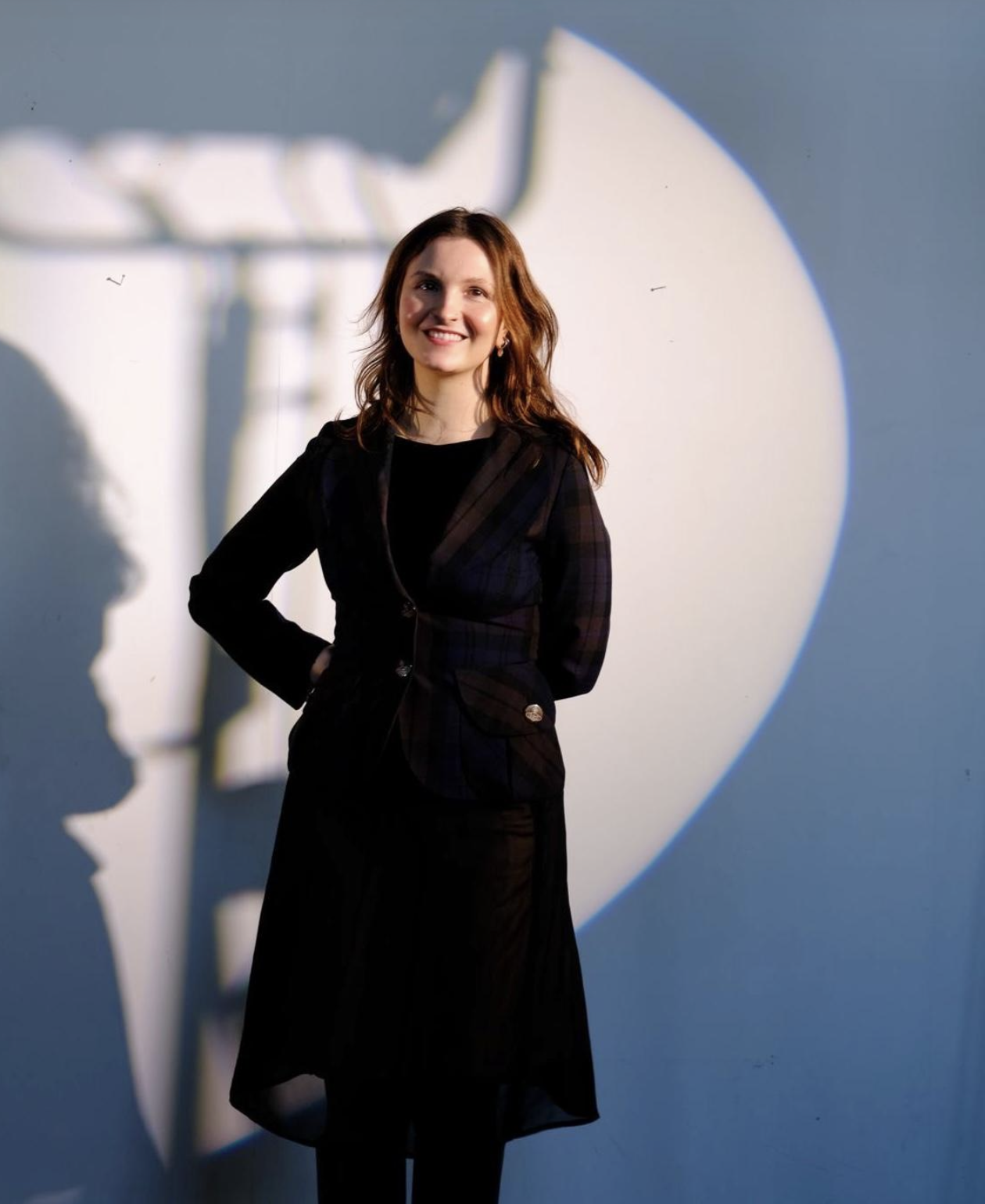
Short Bio
Cosette is a Canadian-born set and costume designer. She completed her Bachelor’s of Costume and Set Design at the National Institute of Dramatic Arts in Sydney, Australia, in 2024, and graduated magna cum laude with a Master’s of Costume Design at the Royal Academy of Fine Arts Antwerp in 2026.
Her practice is inspired by history and narrative, and her work is dramaturgically driven, encompassing dance, opera, theatre, and film. Since moving to Europe, she’s worked as a costume assistant to FC Bergman’s Werken en Dagen (2024) and Opera Metz’s Salome (2024); she has designed the set and costumes for the short film, Homme Sans Qualités (2026), directed by Sofia Romano, and the costumes for JPEG’s production of Toutes Les Beautés du Monde (2026), along with several other projects. She currently lives and works in Brussels, Belgium.
Artist Statement
Cosette’s work is heavily shaped by history and narrative. She grew up with classical musician parents who valued historical knowledge and beauty above all else, which had a tremendous lasting effect on the way in which she learned to view the world.
Her design work is dramaturgically and psychologically driven; she strives to walk along the thin veil between realism and abstraction, reaching for something transcendent while keeping her references grounded in simple, relatable emotion. She is interested in creating work that at once feels like it represents the heart of the world in which we live, while the visual language at times bubbles over, taking on new dimensions of storytelling.
Cosette’s greatest passion lies in conceptualizing the entirety of the treatment of the world in which the performance takes place. Her approach to scenography and costume design involves working around a script, or a conceptual framework, and attempting to extract what the story is asking for in regards to visual language rather than forcing a visual language upon it. This allows for the creative process to feel almost archaeological.
She takes a great interest in the ephemeral art of creating the framework of internal logic within a fictional world that the audience learns to trust. Something so delicate and subtle tha it can hardly be recognized, but is the essential philosophical underpinning to all the elements of a production coming together harmoniously. She strives to tell stories, to create dramaturgically driven visual worlds which people are able to truly escape into, and to create work which is bigger than herself.
Project Statement
My Master’s project questions the presence and need for escapism in our lives, and whether or not, and in what form, it may be passed down intergenerationally.
The costumes attempt to capture something of the internal revolution experienced by the characters who wear them, imbued with the psychological expression brought on by critical moments of escape in the characters’ lives.
This project was born out of my curiosity towards something I repeatedly came across in my research about people living through a period of revolution, as well as something that has always been central to my own experience as a human being: escapism. For me, at the heart of escapism is a yearning for something unreachable, a yearning for a sense of belonging. Alma, my grandmother, was a young teenager in a small village in Poland when World War II began. I came to learn that her bizarre, and sometimes cruel, actions were rooted in her experiences as a young woman during wartime. It wasn’t until she began to lose control of her mental faculties near the end of her life (unable to recognize her own daughter) that she accidentally shared with my mother the painful details of her escape from Poland, including an attack by a group of Russian soldiers. It became clear that in one way or another, she had spent her whole life running from these experiences.
Whether it was her escaping through displacement, escaping through material possessions, escaping through a loveless marriage, or escaping through having a child, it appeared that she was never truly satisfied with her own life, constantly trying to run, to rewrite, to change.
It has fascinated me to realize, despite the peaceful settings in which my mother and I were raised, how my grandmother’s innate desire to escape has seemed to persist in both the lives of her daughter and granddaughter.
Through my Master’s film, Alma: Gilded Wings of a Flightless Bird, my intention has been to use the element of fear that drives the escapism I’ve found in the lives and experiences of my grandmother, my mother, and myself, and to harness it as I begin my career on the continent from which my grandmother fled, and with which my mother spent her life trying to reconnect.
It is fascinating how such a primal emotion as fear can become the motor that drives such a beautiful, deeply creative, phenomenon such as escapism.
My own desire for escape is so closely linked to my work as an artist. It has always been through art and storytelling that I have escaped, and my practice as a costume and set designer has given me the opportunity to build the worlds into which I want to escape.